Preheat Battery by Yoyo Driving
Fast charging in cold weather
The advice here is intended for Enyaq model year 2023 (APP 310 rear motor) and earlier. From model year 2024 (rear motor APP550) there is battery heating system that can be manually activated in the infotainment.
The information here should also be applicable for other MEB cars of model year 2023 or earlier e.g. VW ID3, ID4, ID5, Audi Q4 E-tron, and Cupra Born. It may also be useful as general information for other EVs.
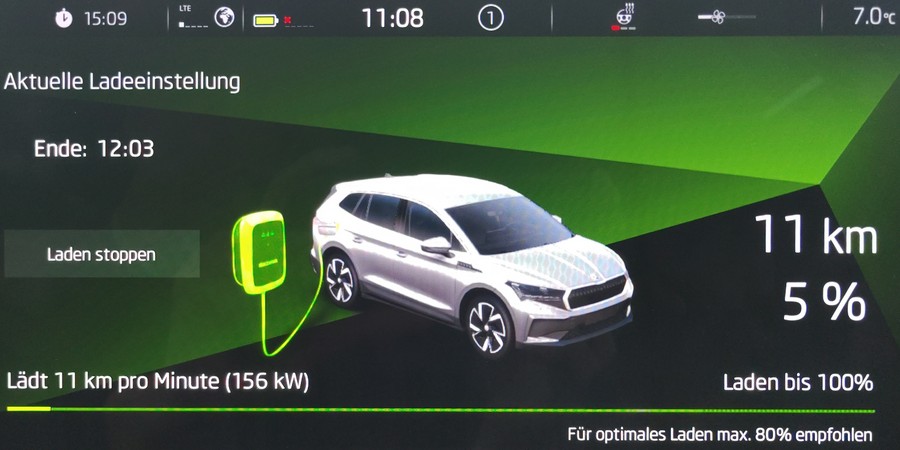 Charging Enyaq 80X at 156 kW after yoyo driving
the battery to temperature ~25°C, while outdoor temperature
7°C.
Charging Enyaq 80X at 156 kW after yoyo driving
the battery to temperature ~25°C, while outdoor temperature
7°C.
Fast charging
To charge fast you need to start at low %SOC (State Of Charge). Aim for arriving with <15% SOC.
To charge fast the battery needs to be warm. Normal motorway (or country road) driving does not heat the battery much, it will have a temperature little more than the outdoor temperature. Only for <0°C there is battery heating, spending battery energy to heat the battery.
To monitor the battery temperature use an OBD2 dongle and CarScanner app.
CarScanner has multiple screens that show battery temperature. Enyaq has many battery temperature sensors, 2 per battery module, also at battery power connection + more. There can easily be 3-5°C difference of temperature at different locations in the battery. In cold / cool weather it is the lowest temperature that limits max charge power.
The following temperatures refer to the lowest temperature reading of the battery. For 80X and RS:
- If the battery temperature is >=25°C, max charge power is ~155 kW.
- If the battery temperature is >=30°C, max charge power is ~175 kW.
Likely at >40°C the max charging power will be reduced to avoid over heating the battery. However no detailed info available about this.
For models 80 and 60 max charge power is at >=25°C (not tested).
- Model 80 max charge power is ~143 kW.
- Model 60 max charge power is ~124 kW.
 Charging Enyaq 80X at 174 kW with battery at ~30°C,
no yoyo driving needed as outdoor temperature 30°C.
Charging Enyaq 80X at 174 kW with battery at ~30°C,
no yoyo driving needed as outdoor temperature 30°C.
Heating the battery
When the battery is fast charged (DC charging) it slowly heats up. So after charging the battery is significantly higher temperature than at start. The battery is also heated when AC charging, but the heating is so slow that it dissapate due to cooler outside temperature.
All battery cells have a tiny internal resistance. This resistance is a parasitic effect, and it will slowly increase as the battery age. The internal resistance cause a few % loss of energy when charging battery and again when discharging (use) battery. The lost energy becomes heat, and that heat increases the temperature of the battery.
Yoyo driving and battery heating on route
When using regen braking the energy generated is stored back in the battery. Due to the internal battery resistance it slowly heats up the battery.
On the cockpit display, below the %SOC and remaining km range, there is a blue and green bar. The blue bar is regeneration, the green bar is acceleration. When blue bar is shown but less than full, only regen is used to slow the car. If blue bar is full the actual brakes are used to slow down the car. For efficient regen full blue bar should be avoided. Aim for ~67% blue bar.
Yoyo driving is to increase speed, then let regen slow down the car, then repeat new cycle of speed increase, followed by regen slow down. Again and again. Typically on a motorway with max 130 km/h, you will yo-yo between 110 and 130 km/h.
ONLY yoyo drive if there is NO OTHER traffic. Yoyo driving can cause problem for cars behind you. There should be >200 m behind and >100 m in front to nearest other vehicle.
Strong yoyo driving can also be annoying to passengers in the car. They can get motion sickness.
Easy yoyo: ACC and accelerator
On a motorway with max 130 km/h, set the ACC (Adaptive Cruise Control) speed to 110 km/h. This is your base line speed. With accelerator pedal manually increase speed to 130 km/h. Take foot off aceelerator and let car regen down to 110 km/h. The car will use medium level regen, so brake lights will NOT turn on. Medium level regen is also less annoying for passengers.
Aim for blue regen bar on cockpit display to be max 67% full. If blue bar becomes longer the regen is too strong and brake light may be lit up. In this case accelerate again to 130 km/h.
From empirical evidence you need ~5 cycles of 110-130-110 km/h to increase battery temperature 1°C.
Depending on how much you need to increase temperature, you may have to yoyo drive for 10-20-30 km before arriving at DC charger.
This easy yoyo is the recommended method.
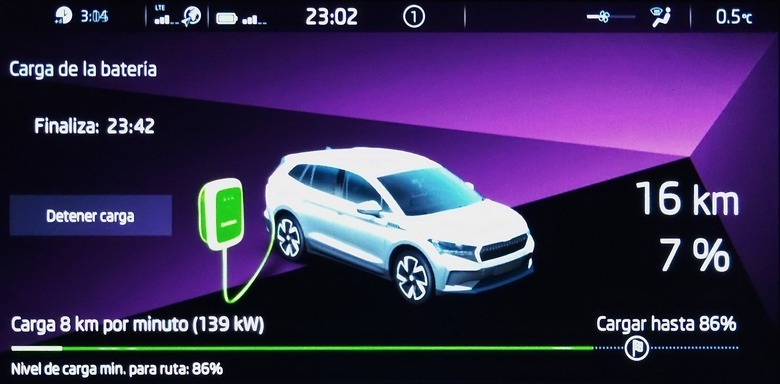 Charging Enyaq 80X at 139 kW after yoyo driving battery to ~24°C, Outdoor temperature 0.5°C.
Alternative yoyo: Steering wheel paddles
You can yoyo drive by using the paddles on the steering wheel. The paddles worrks in gear select D mode and not in travel assist nor ACC mode. Paddles has 4 levels 0 to 3:
- 0: Coasting, no regen
- 1: Light regen, short blue bar
- 2: Medium regen, medium long blue bar
- 3: Strong regen, often full blue bar, brake lights turns on!
On a motorway use paddle level 2 for medium regen. This avoids brake lights activating.
This method Works but is troublesome to use.
Method is NOT recommended.
Alternative yoyo: B-mode
You can yoyo drive with gear selector in B mode. On a motorway B-mode is similar to paddles level 3, with strong regen and brake lights activating.
This method is annoying to passengers and to any other traffic on the road.
Method is NOT recommended.
Tags: Enyaq, Preheat Battery, Yoyo
Page link: <http://foersom.org/EV/Skoda/Enyaq/PreheatBatteryYoyo.html>
Edited: 2025-12-29